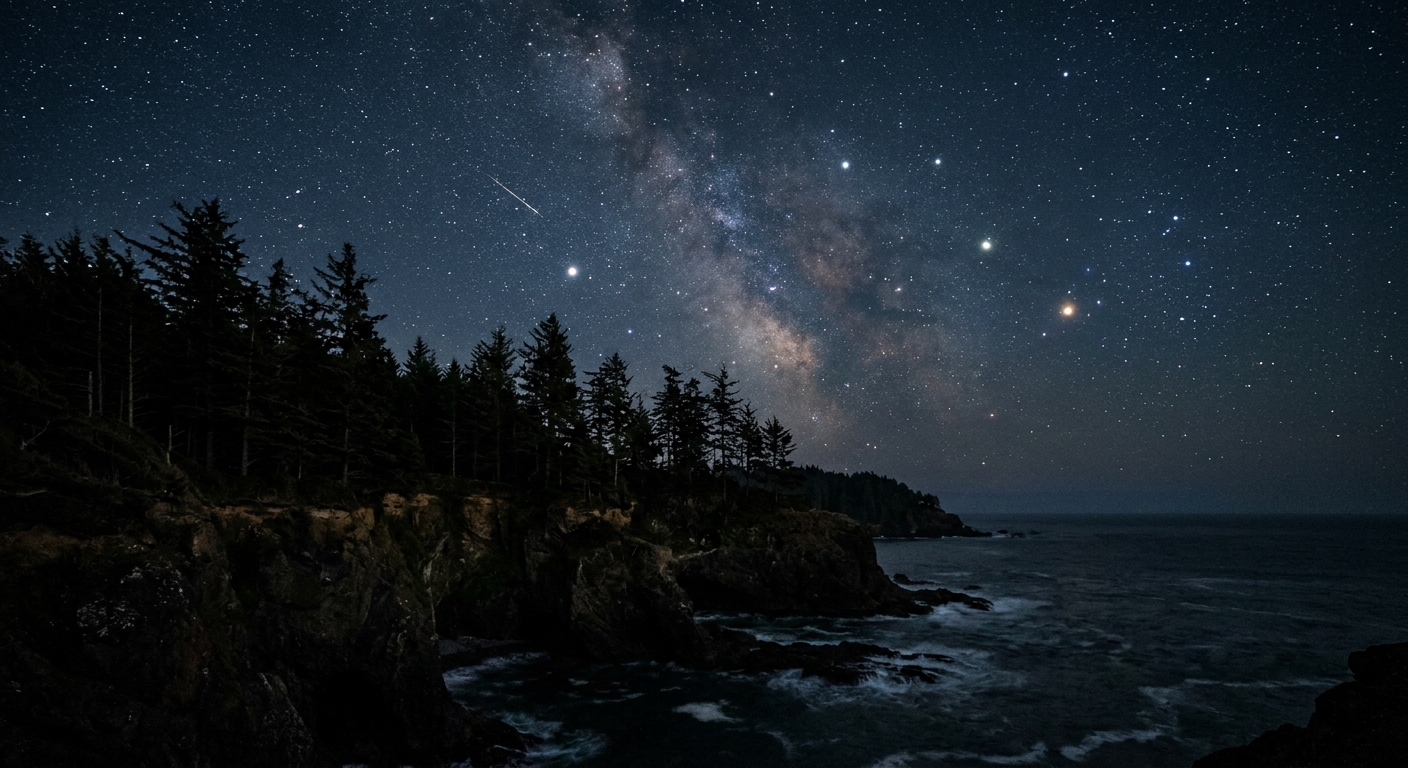
AI-generated illustration; not a photograph of the reported event.
- calendar_today November 17, 2026
Bright Planets Meet in Pre-Dawn Skies
Stargazers in Oregon and Washington are set for a rare celestial double feature in mid-November as a close alignment of Mars and Jupiter is followed by the annual Leonid meteor shower. Weather permitting, these astronomical events will offer spectacular viewing opportunities for sky watchers along the coasts and inland areas.
Mars and Jupiter Conjunction on November 15–16
According to Jim Todd, space expert at the Oregon Museum of Science and Industry (OMSI), Mars and Jupiter will appear strikingly close together in the pre-dawn hours of November 15 and 16. While the planets reach their closest apparent separation at 6:04 p.m. PST on November 15, the best time to view them is before sunrise, when both are visible above the eastern-southeastern horizon.
“The two planets will shine just 1.2 degrees apart, roughly twice the width of a full moon, or the width of your little finger held at arm's length,” Todd explained. This event unfolds in the constellation Leo, near the bright star Regulus. Jupiter, with its steady creamy-white glow, will far outshine the reddish-orange point of Mars.
No special equipment is required to enjoy this conjunction, though binoculars or a low-power telescope will allow viewers to see both planets within the same field of view, Todd added.
The Leonid Meteor Shower Peaks Late November
Just two days after the planetary conjunction, the Leonid meteor shower will reach its peak from late November 17 through dawn on November 18. The shower, which occurs annually as Earth crosses the debris trail left by Comet Tempel-Tuttle, typically offers up to 15 meteors per hour at its height.
The Leonids are renowned for producing bright fireballs as well as persistent trains—lingering glowing trails that remain after the meteors flash by.
How and When to View the Leonids
Jim Todd recommends watching the sky between 2:00 a.m. local time and morning twilight, once the constellation Leo has risen higher in the sky and the first-quarter moon has set. “Find a dark spot with a wide, unobstructed view of the sky away from city lights,” he said. No special equipment is needed, but binoculars can provide a better look at longer-lasting meteor trails.
The Leonids are visible to the naked eye, and viewers along the Oregon and Washington coasts might enjoy clearer night skies than those farther inland, depending on weather conditions.
Behind the Show: Comet Tempel-Tuttle
The annual meteor shower is caused by dust and rocky particles left behind by Comet Tempel-Tuttle. As Earth moves through this debris, the particles burn up due to friction with the atmosphere, creating the streaks of light known as meteors. The Leonids get their name from the constellation Leo, the apparent origin point of these meteors.
Additional Astronomy Resources and Events
For more information on current celestial events or to deepen your astronomical knowledge, OMSI offers a daily Starry Night Live! presentation in the Kendall Planetarium. Schedules and further details are available at OMSI.edu.
Weather plays a crucial role in visibility along the coastlines. For those traveling to observe these events, up-to-date weather resources can be found for the Washington Coast and the Oregon Coast.
Source: beachconnection.net.