- calendar_today August 8, 2025
.
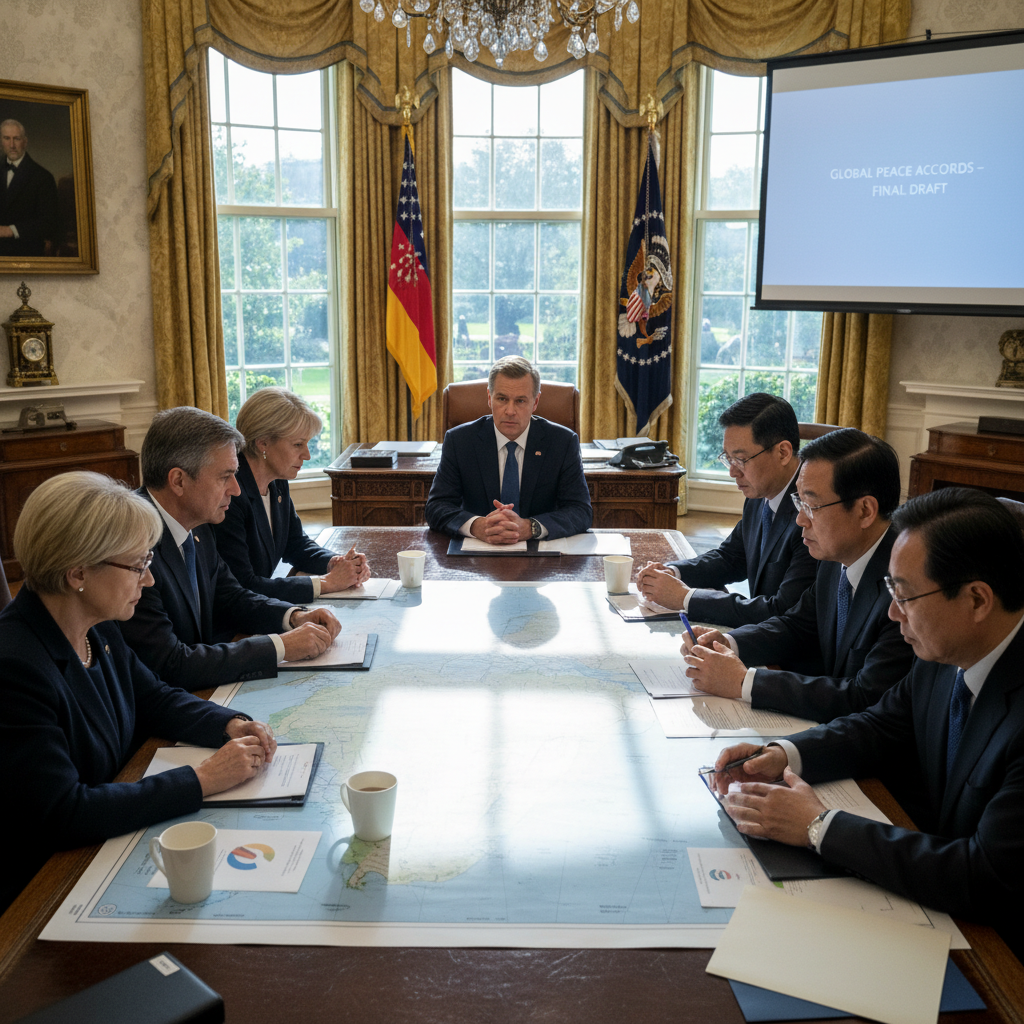
President Donald Trump is reviving his role as a global dealmaker, this time by claiming that he has ended six wars in his second term. He made the comments Monday in the Oval Office with Ukrainian President Volodymyr Zelensky and other European leaders, also promising headway in ending the war in Ukraine.
“I’ve done six wars — I’ve ended six wars,” Trump said. “Look, India-Pakistan, we’re talking about big places. You just take a look at some of these wars. You go to Africa and take a look at them.”
The White House has been touting Trump’s record as the “President of Peace” in recent weeks, with a statement earlier this month listing claimed achievements in multiple regional conflicts. They included Armenia and Azerbaijan, Cambodia and Thailand, Israel and Iran, Rwanda and the Democratic Republic of the Congo, Egypt and Ethiopia, and Serbia and Kosovo.
Administration officials have also mentioned the Abraham Accords signed during Trump’s first term that normalized relations between Israel and several Arab nations.
Deal or No Deal?
His comments have raised questions about whether Trump is offering real solutions to conflicts or just branding ceasefires as historic peace accords. The truce between Israel and Iran, for example, marked an end to a 12-day confrontation, but the underlying tensions over Tehran’s nuclear program remain.
His previous efforts in the Middle East also underscore the limitations of his dealmaking. Peace efforts to stop violence between Israel and Hamas collapsed. He also held two summits with North Korean leader Kim Jong Un in his first term that did not lead to any breakthrough, and Pyongyang since has expanded its nuclear arsenal.
Symbolic Successes
Trump has nonetheless been able to claim some symbolic achievements. Earlier this month, Armenia and Azerbaijan signed a declaration at the White House to “recognize” borders and “renounce the threat or use of force” against each other. They also agreed to a U.S.-backed transportation corridor, dubbed the “Trump Route for Peace and Prosperity.”
Azerbaijani President Ilham Aliyev hailed the “miracle” deal, but analysts say many contentious territorial issues remain.
His role in peacemaking in Southeast Asia earlier this year also illustrated how he wields economic leverage to stop the violence. Fighting between Cambodia and Thailand had killed 38 people before Trump threatened to suspend trade deals with the governments of both countries unless they halted the fighting. The Association of Southeast Asian Nations (ASEAN) helped facilitate the final agreement, but Cambodian Prime Minister Hun Manet still singled out Trump, even nominating him for the Nobel Peace Prize for his “extraordinary statesmanship.”
Trump later intervened again in a May border clash between India and Pakistan. Pakistan was effusive in its praise for Washington’s role, but India denied the U.S. had been critical. The ceasefire remains fragile, with the two sides still at odds over the disputed territory of Kashmir, a frequent flashpoint for war.
Trump has also taken credit for a deal between Rwanda and the Democratic Republic of the Congo. The agreement, which both countries have signed, calls for border recognition and disarmament of armed militias.
The M23 rebel group rejected the deal, raising questions about whether it will hold. U.S. strategic interests are also at play, with the deal seen as strengthening Washington’s position in its competition with China for Africa’s mineral resources.
In his claims on Egypt and Ethiopia, Trump has gotten involved in their long-running standoff over a massive Nile dam project, and he has pushed for compromise. But no binding deal has been agreed to.
The White House has also pointed to several normalization measures between Serbia and Kosovo that predate his first term. The two nations remain at odds, and recent talks were largely driven by the European Union.
On-the-Record Questionable Impact
Trump’s reliance on unconventional diplomacy — favoring brash pronouncements and personal branding over private negotiations — has produced decidedly mixed results. Critics say his downsizing of the State Department and cuts to the U.S. Agency for International Development have undercut America’s ability to build on short-term deals and create long-term peace.
Some observers, though, have noted that his interventions have been on occasion effective. Celeste Wallander, a former assistant secretary of defense who is now with the Center for a New American Security, said Trump’s role in lowering tensions between India and Pakistan was handled “in a professional way, quietly, diplomatically, but also finding common ground between the parties.”
As he now looks to make his mark on the war in Ukraine, the question is whether his record so far portends lasting diplomacy or short-term fixes. His track record so far has shown both: headline-grabbing agreements that have proven to be far from permanent peace, alongside a handful of cases where U.S. pressure has been able to prevent conflicts from spiraling further. How long those outcomes will last is still an open question.