- calendar_today August 17, 2025
No Homework Needed: A Low-Stakes Marvel Reboot
Marvel’s The Fantastic Four: First Steps is a cheerful, nostalgic reboot of one of the comics publisher’s first teams, full of retro eye candy and solid performances (particularly from Pedro Pascal and Ebon Moss-Bachrach). It embraces the era it channels (think muscle shirts and bright colors) with aplomb and panache. But it never quite amps up the suspense or stakes to warrant such fanfare.
Producer Kevin Feige described the film to me as “a no-homework-required” kind of movie, and he’s not wrong. In a Marvel Cinematic Universe with increasingly elaborate layers of multiverses, and a Spider-Man spinoff directly referencing a different Spider-Man spinoff, it’s nice to see a Marvel movie that requires little to no knowledge of the interconnected saga. The Fantastic Four: First Steps reintroduces us to the quartet’s early days without delving too deeply into the morass of continuity established in previous efforts. In that sense, the film is refreshingly — and sometimes frustratingly — no-frills.
It begins with a talk show being hosted by Mark Gatiss, whose handsome, well-coiffed avatar is regaling an audience with details of how these four came to be the Fantastic Four. Four years earlier, a science experiment during a cosmic space mission left Reed Richards (Pascal), Sue Storm (Vanessa Kirby), Johnny Storm (Joseph Quinn), and Ben Grimm (Moss-Bachrach) exposed to a radiation source that rearranged their DNA. Reed has the power to stretch his body like taffy. Sue can vanish from sight and project force fields. Johnny can combust and fly. And Ben, well, the science accident made him The Thing, a permanently rock-covered giant with the strength to match.
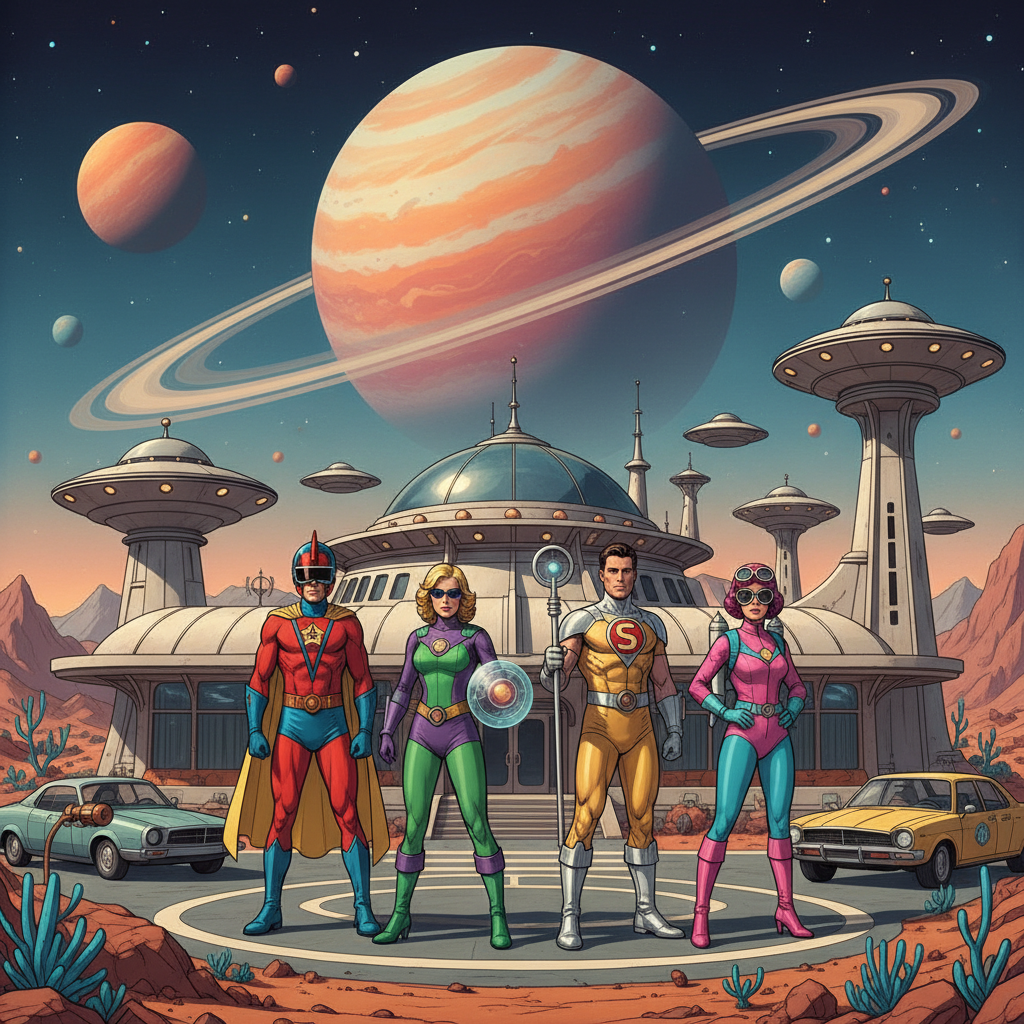
The quartet shares a home that could only be described as a 1960s-ish set-dressing play on a mid-century modern space compound with flying cars, chalkboard equations, and a toddler-sized robot named H.E.R.B.I.E. lending a hand. First Steps is one big exercise in retro-futurism. Square television screens. No phones. Even the three primary lab-coated scientists on the crew feature pastel-colored elbow patches on their jackets. The earth-orbiting base they live in is lovingly adorned with an optimism that borders on the cartoonish. You could almost imagine the special effects of The Jetsons colliding with Lost in Space bouncing off the cover of a Marvel comic book.
But the world is missing a sense of urgency. First Steps is, above all, a love letter to family. To the all-for-one-and-one-for-all familial bond between the four leads. Sue gets pregnant early in the movie, and Reed’s response is both amusing and appropriately neurotic. The film features a sublime bit in which he’s having H.E.R.B.I.E. do a walkthrough of the house and science lab, double-checking to make sure baby-proofing is implemented. In the meantime, Johnny and Ben do dorky, sibling-like sniping, comic relief, and manifestly seem to be enjoying being baby brothers-to-be, a pair of long-awaited-forbidden fruit.
This would be lovely if it didn’t have a story to tell. The moment of peace is soon shattered when the ground shakes onscreen in a theatrical rumble. Galactus, a giant armored figure with cosmic eyelights, is making his way toward Earth with plans to eat the planet, and presumably, his new neighbors. Before he arrives, he sends his herald out to give the bad news. The herald, The Silver Surfer, has the lean body of Julia Garner on display through motion capture, and a silverish skin tone that glows like mother-of-pearl. She arrives on a surfboard-like board, with shiny menace. But almost immediately, she becomes a source of petting, and something more, for Johnny.
The mix of earnest and absurd characterizes the whole affair. There are moments of true sincerity, but they are frequently overwhelmed by the candy-floss-pastel color wash of it all. The stakes never feel quite high enough, even when the fate of the Earth is at risk. It’s more Child’s Play than Event Horizon.
Marvel’s The Fantastic Four: First Steps is sweet, well-intentioned, and features some fine performances. But at the end of the day, it doesn’t have the theatrical stakes or dramatic energy of the publisher’s best entries. It’s accessible, nostalgic, and heartfelt. But it’s also light on thrill. It may be just right for those who like their superheroing a little less world-ending and a little more whimsical. It may, for others, be a beautifully decorated parcel that looks better on the outside than what’s within.