- calendar_today August 7, 2025
Local Game Stores Could Suffer From Tariff Ripple Effects
In an industry noted for creativity, closeness, and, for the most part, low profit margins, this week’s announcement of a 54 percent tariff on goods printed in China and shipped to the United States has reverberated like a body blow.
Designer Jamey Stegmaier, whose Scythe and Wingspan are among the most popular board games in the world, voiced his alarm and frustration this week in a blog post that was striking in both its passion and its candor.
“I don’t usually do personal blog posts,” Stegmaier, who founded and runs the successful Stonemaier Games company, wrote. “But last night I tried to work on a new game I’m brainstorming, and it’s tough to build something for the future when that future looks so grim. I mostly just found myself staring blankly at the enormity of the newly announced 54 percent tariff.”
Designed for the Globe
The United States has long depended on China for manufacturing board games. Germany has its facilities for printing cards and assembling games, and Germany is, of course, the spiritual center of modern tabletop gaming. But a full-on production run, the sort of deal that includes not only printed cards but custom plastic miniatures, wooden tokens and stands, die-cut boards, specialty dice, and so on, is overwhelmingly likely to come from a Chinese printer.
Printing domestically is certainly possible in theory, but in practice, outside of extreme cases, it is, for the moment, financially untenable. Stegmaier remembered that, years ago, he was once quoted $10 by a domestic manufacturer for “not even the game itself but just the empty boxes the game would come in.” By contrast, $10 will cover the cost of printing and packaging an entire game in China.
That’s why this latest announcement, short notice and all, is such an existential threat to U.S.-based publishers. Sure, most American board game companies make their money on extremely thin margins. But it’s a short leap to the vanishing point.
Board game bigwigs, including both Meredith Placko, CEO of Steve Jackson Games, and Jamey Stegmaier, have spoken out in the last week. SJG, the publisher of games including the zany Munchkin franchise, is hit just as hard as anyone, since it also outsources manufacturing overseas.
“In short,” Placko writes, “right now is a giant cluster of f*** for SJG and most other board game companies.”
“Manufacturing in the US?” Placko wrote in a recent blog post. “I wish we could. But the infrastructure to support full-scale boardgame production—specialty dice making, die-cutting, custom plastic and wood components—doesn’t meaningfully exist here yet. I’ve gotten quotes. I’ve talked to factories. Even when the willingness is there, the equipment, labor, and timelines simply aren’t.”
For Placko and others, this is not a “policy change,” but a tectonic one for the entire American board game industry.
Restoration Games founder and Pandemic Legacy designer Rob Daviau has been sounding the alarm for months on Twitter, where he’s described most of his business meetings in the last year as “an existential crisis about our industry.”
In an interview with BoardGameWire last week, he said his conversations on the topic had led him to a stark prediction. “I don’t know about you,” he said. “But if tariffs like this were ever put in place, I predict a great collapse in the hobby gaming market in the US.”
The Domino Effect
Gamers themselves could be directly affected as well. New games will have to cost more to purchase, of course, but some companies may also cut corners to maintain current prices, leading to a drop in production quality. In other cases, companies may simply scale back on their new releases to the point where supply slows or dries up.
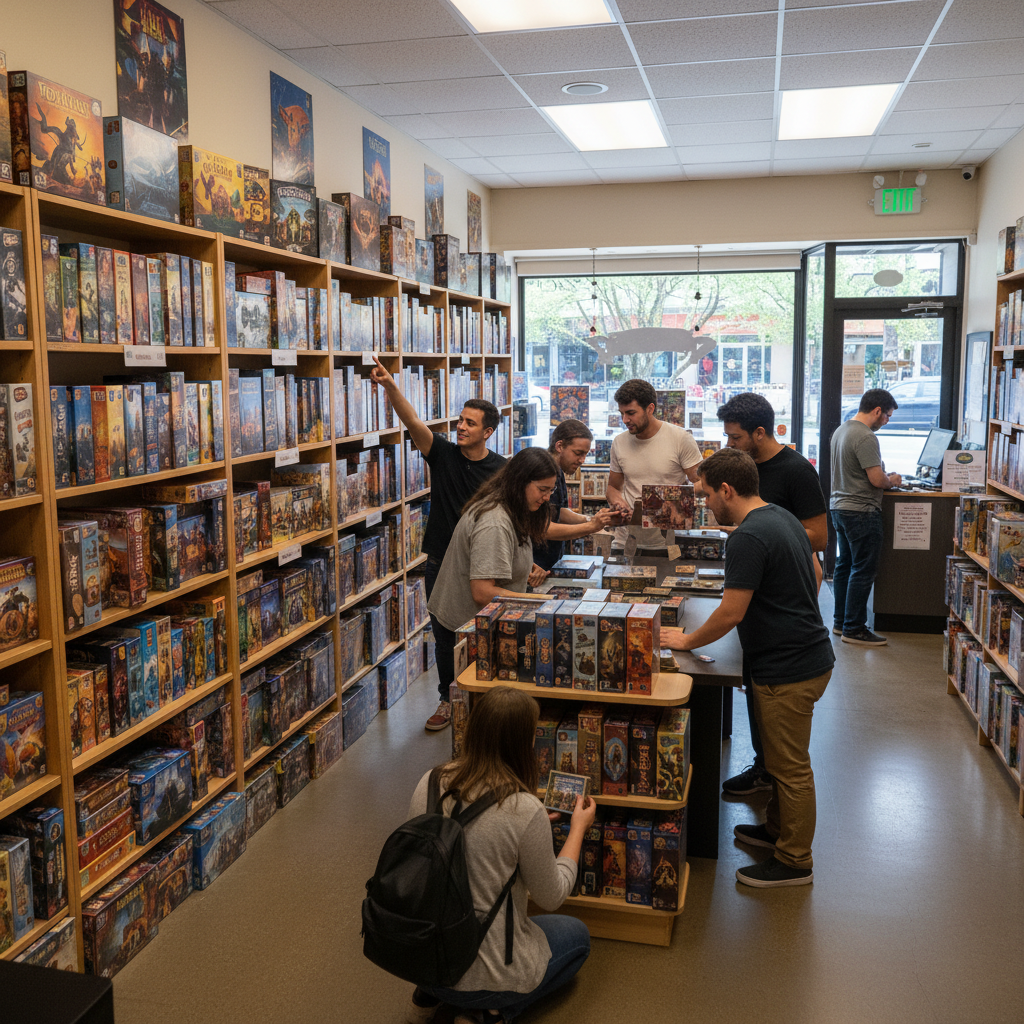
Physical game stores, long-suffering from an online market that’s made shopping easier and cheaper for gamers, may also suffer from this new directive. Gamers may stick to their shelves, including all the unplayed games already collecting dust on their “shelves of shame.” Or they may buy games online rather than from their local game store.
“As a result of the 54% tariff, within a few months, US companies will lose a lot of money and/or go out of business,” Stegmaier writes. “And US citizens will suffer from extreme inflation.”
Small Loopholes
Publishers can try to route their shipments through non-U.S. distributors and warehouses, Stegmaier notes, something he’s done in the past since European markets have not been hit by these sorts of tariffs. It’s not a real workaround for U.S. companies, however. As he writes, 65 percent of Stonemaier Games’ sales are in the U.S., so he’ll be taking a hit even if some of his new games do get sold in Europe.
What’s more, some companies may be able to shift around the budgeting for games that have yet to enter the full production cycle or that are still in the design phase. But for any game already printed, packaged, and en route from China, it’s too late. Games at the printing stage have no choice but to absorb the tariff.
Chris Solis, owner of California-based Solis Game Studio, reports he is among the latter. “I have 8,000 games leaving a factory in China this week and now need to scramble to cover the import bill,” he told The Washington Post. “I wish there was some way to back out of that contract, but no, they’re just shipped.”
Time for Change?
The Game Manufacturers Association (GAMA), a trade group that represents the interests of board game publishers, has been active in opposing the tariffs, but those efforts have yet to have any discernible effect.
As things stand now, the U.S. board game industry is facing an event unlike any in its modern history. An industry devoted to fun, creativity, community, and the simple pursuit of joy now finds its future extremely uncertain.