- calendar_today August 10, 2025
Smoke-stained curiosities: MJT’s painstaking recovery
If you’re not familiar with Los Angeles’ Museum of Jurassic Technology (MJT), you’ve probably heard of it. One of the city’s most distinctive cultural institutions, it’s become a local treasure, and a curiosity to visitors. The museum suffered a fire this month that caused significant damage, destroying the gift shop and causing smoke damage to much of the museum. It is expected to reopen sometime next month.
The unusual museum has long held a niche place in LA’s cultural history. Founded in 1988 by David Hildebrand Wilson and Diana Drake Wilson, the museum has attracted visitors to its unconventional exhibits since its inception. On the museum’s website, the “Hours and Admission” section says that it is “dedicated to the advancement of knowledge and the public appreciation of the Lower Jurassic”. However, while its name seems to indicate an interest in natural history, its collection has less to do with the Jurassic period than it does with the Renaissance and their cabinets of curiosity, or wunderkammers.
Not all the exhibits are fiction. Many draw upon obscure and genuine historical artifacts. Layered with fact and fiction, others deliberately obfuscate where the line between real and imagined occurs. For example, one of the permanent exhibits honors Athanasius Kircher, an actual 17th-century Renaissance polymath and Jesuit priest. Another is dedicated to the work of Armenian artist Hagop Sandaldjian, who crafted ultra-miniature sculptures small enough to fit inside the eye of a needle using nothing more than a single human hair.
There are other, even stranger exhibits. One room, for instance, holds decomposing dice that once belonged to the magician Ricky Jay. Another, “The Garden of Eden on Wheels,” is a visual history of trailer parks from across the LA area. Stereographic radiographs of flowers, microscopic mosaics made from scales taken from butterfly wings, and a collection of seemingly nonsensical letters written to the Mount Wilson Observatory between 1915 and 1935 by amateur astronomers are other strange collections. The museum, since 2005, has even had a Russian tea room, which was a replica of the study of Tsar Nicholas II in the Winter Palace of St. Petersburg.
Firefight and Aftermath
In a story published earlier this month by writer Lawrence Weschler, who wrote a 1996 book, Mr. Wilson’s Cabinet of Wonder, which closely examines the provenance of many of MJT’s exhibits, we get some idea of how the fire started. David Wilson, who still lives in a residence behind the museum, first noticed smoke and fire coming from the museum late on July 8. He quickly made his way to the building and, armed with two fire extinguishers, began to fight the blaze. Wilson later described the sight: “a ferocious column of flame”, climbing up the corner wall that faces the street.
The extinguishers he had, however, were not nearly up to the task of fighting the fire’s advance. Luckily, his daughter and son-in-law were soon at his side with a much larger extinguisher. By the time fire crews arrived on the scene, they were able to contain the flames to the gift shop and most of the smoke. “If you had been one minute later, we’d have lost the whole building,” Wilson was later told.
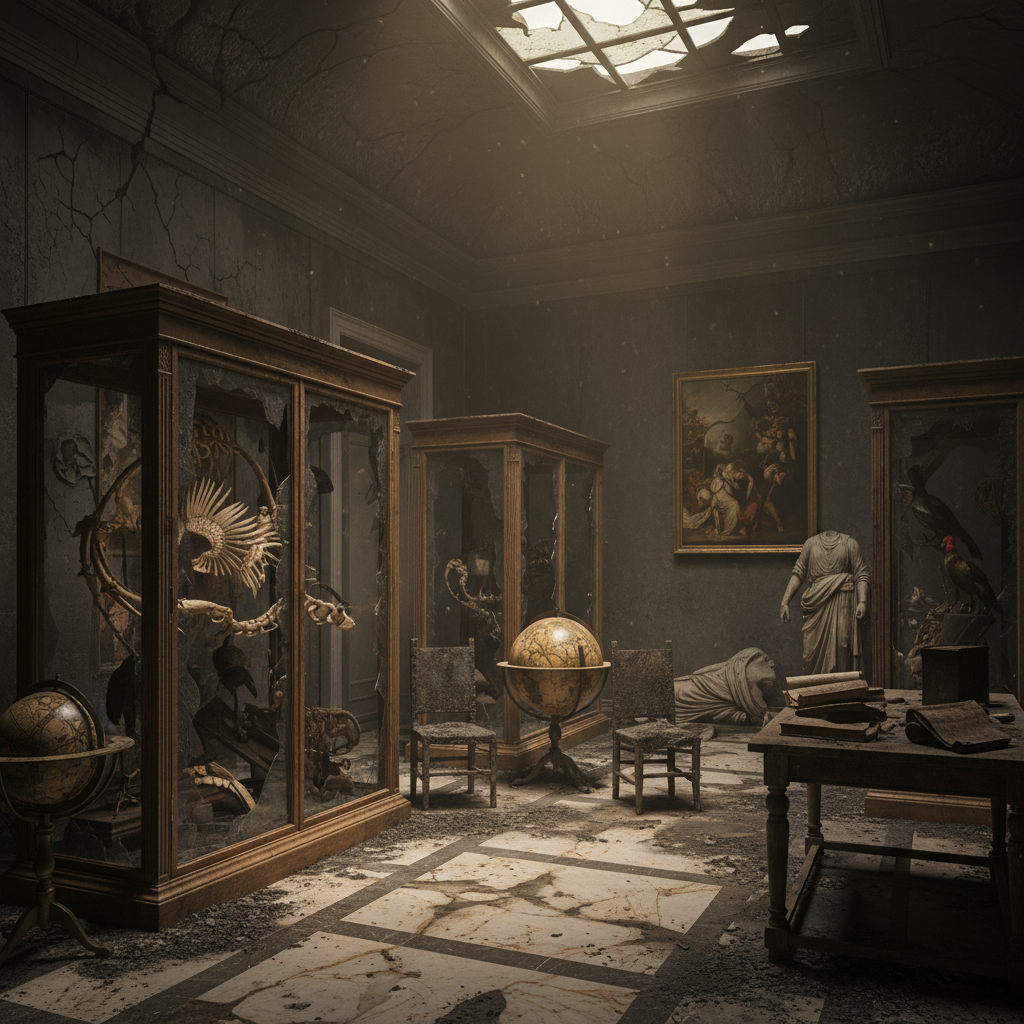
While the gift shop was mostly a total loss, smoke had seeped into many parts of the museum, and its presence throughout the building is a problem. Wilson described the museum: “It was like someone had taken a thin creamy brown liquid and evenly poured it over all the surfaces—the walls, the vitrines, the ceiling, the carpets, and eyepieces, everything.” For a museum that prides itself on its attention to detail and presentation, smoke damage presents an enormous challenge. Many staff members and volunteers have worked tirelessly to repair and clean areas of the museum affected by the fire. According to Weschler, the progress has been slow and incredibly labor-intensive.
In the meantime, Weschler has been encouraging people to make donations to the museum’s general fund to combat revenue losses and repair costs. He wrote that MJT is “one of the most truly sublime institutions in the country…a miraculous and eccentric place that stands outside the usual categories of science and art and narrative. I do not doubt that it will eventually reopen and that, when it does, it will be as splendidly weird and wonderful as ever.” There’s no word yet on when the museum will reopen, but when it does, you can be sure it will be exactly as you’d expect: satirical, scholarly, and surreally strange.