- calendar_today August 13, 2025
In 2025, Oregon’s commercial real estate (CRE) market is transitioning from post-pandemic recovery to long-term reinvention. Across Portland, Eugene, Bend, and beyond, demand is shifting—but not shrinking. As employers adapt to hybrid models and consumers embrace suburban convenience, developers and investors are reimagining what Oregon’s built environment should look like.
Despite economic uncertainty and rising construction costs, Oregon’s fundamentals remain strong. The state’s commitment to sustainability, its growing population in second-tier metros, and its role as a Pacific Northwest logistics hub are keeping the CRE market attractive, particularly for industrial, multifamily, and niche retail.
Industrial Real Estate: Oregon’s Quiet Powerhouse
Oregon’s industrial market has become a key driver of commercial real estate in 2025. Logistics, warehousing, and light manufacturing are in high demand, especially in Portland’s metro area and along the I-5 corridor.
Portland’s industrial sector remains robust, with vacancy rates holding below 4% and strong absorption in submarkets like Gresham, Hillsboro, and North Portland. Facilities with proximity to the Port of Portland and rail lines are especially competitive, attracting regional distributors and e-commerce firms looking for faster West Coast coverage.
In Mid-Valley regions like Salem and Albany, industrial parks are expanding to support food processing, green manufacturing, and semiconductor suppliers. Incentives through the Oregon Enterprise Zone Program are fueling site selection interest in less-saturated counties, especially for developers seeking land at a lower basis.
Multifamily: Stable Demand with Focused Growth
In 2025, Oregon’s multifamily sector continues to be buoyed by steady in-migration and a constrained housing supply. The state’s urban cores—especially Portland and Eugene—are seeing the return of renters after a brief COVID-era exodus. At the same time, suburban markets are driving new multifamily development.
Portland’s inner eastside and transit-oriented zones are experiencing renewed interest from developers building energy-efficient apartments targeted at young professionals. While rent control laws have slowed speculative projects, stabilized Class B and workforce housing remain attractive to long-term investors.
In Eugene and Bend, college enrollment and population growth are pushing demand for student housing and mid-rise apartments. Build-to-rent (BTR) models are gaining ground in outer-ring areas where land is more readily available and renters seek single-family layouts without ownership responsibility.
Occupancy rates remain strong—averaging above 93% statewide—with moderate rent growth expected through 2026, particularly in low-supply submarkets.
Office Market: Restructuring, Not Retreating
Like many U.S. markets, Oregon’s office sector has undergone significant correction. In 2025, the Portland CBD continues to struggle with high vacancy—north of 22%—amid hybrid work trends and corporate downsizing.
However, the market is showing signs of bottoming out, with Class A spaces in key suburban submarkets like Beaverton, Lake Oswego, and Tigard experiencing healthy leasing activity. Tenants are consolidating footprints while prioritizing buildings with modern HVAC, ESG certifications, and amenity-rich campuses.
Medical office buildings (MOBs) and life sciences properties are outperforming traditional general office space. OHSU’s South Waterfront campus continues to spur development in adjacent parcels, attracting biotech firms and research centers.
Developers are also exploring adaptive reuse of vacant downtown office space—transforming towers into residential or mixed-use formats to revitalize urban cores.
Retail: Survival of the Savviest
Oregon’s retail CRE sector is adapting in 2025 through experience-focused centers, localism, and suburban migration. While traditional malls continue to decline, open-air retail, grocery-anchored plazas, and walkable mixed-use districts are outperforming.
In Portland, retail corridors like Division Street, Alberta, and Slabtown are thriving with independent coffee shops, boutiques, and hybrid service providers (think yoga-meets-café concepts). Retailers that emphasize ethical sourcing, zero-waste packaging, or community alignment are resonating with Oregon’s values-driven consumers.
Suburban retail in areas like Tualatin, Sherwood, and Hillsboro is benefiting from residential growth and higher foot traffic. Leasing activity for small-format Target, Trader Joe’s, and health & wellness tenants remains strong in these centers.
Retail vacancy is holding around 5.7%, and lease rates are stabilizing thanks to demand from experiential tenants and essential service providers.
Sustainability Is Not a Trend—It’s a Requirement
In Oregon, green building is no longer a niche—it’s a standard. In 2025, developers are under growing pressure from both regulators and tenants to prioritize carbon-neutral construction, water conservation, and LEED certification.
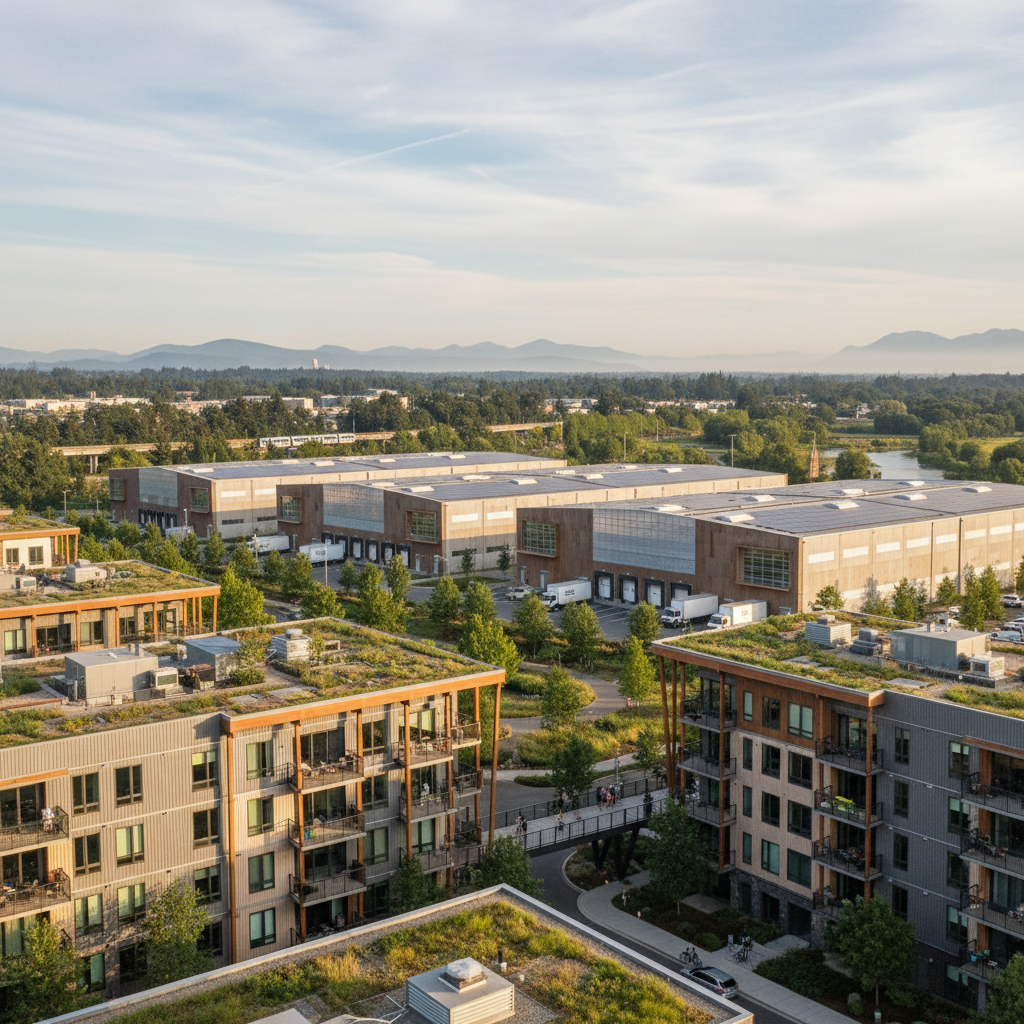
Projects like the Carbon12 building in Portland, once the tallest mass timber structure in the U.S., have set the tone for what’s expected in future developments. Across the state, mass timber, solar integration, and net-zero targets are now common in proposals for industrial warehouses, apartments, and office parks.
Oregon’s strict building codes and sustainability incentives—like those offered through Energy Trust of Oregon—are supporting this shift, even as it increases upfront development costs. ESG-minded investors are viewing Oregon as a laboratory for scalable green CRE models.
Secondary Markets Take the Spotlight
While Portland remains Oregon’s commercial hub, cities like Bend, Medford, Corvallis, and Salem are stepping into the spotlight in 2025. These secondary markets are seeing a rise in flexible office developments, boutique hospitality, and health care-focused real estate.
In Bend, an outdoor recreation economy and influx of remote workers are fueling demand for coworking spaces, micro-retail, and Airbnb-style hospitality assets. Salem’s government and logistics-driven economy supports a growing need for medical office space and affordable multifamily units.
Developers are watching these cities for low-barrier entry points and less competition, with several funds targeting tertiary markets for build-to-core or value-add strategies.
Policy and Infrastructure: The Foundations of CRE
Oregon’s regulatory environment is both a challenge and a guidepost for developers. Land-use laws remain strict, particularly inside urban growth boundaries (UGBs), making entitlement processes complex but predictable.
Recent investments in infrastructure—especially in public transit, EV charging networks, and broadband expansion—are enhancing the long-term attractiveness of CRE projects throughout the state. Portland’s MAX light rail and proposed transit-oriented developments are central to urban redevelopment strategies.
At the state level, efforts to address homelessness and housing affordability will directly shape multifamily policies and CRE incentives through 2026.
2025 Outlook: Resilience Built Into the Foundation
Oregon’s commercial real estate market in 2025 is not without its headwinds—rising interest rates, entitlement delays, and cost overruns continue to weigh on speculative development. But with a strong industrial backbone, sustainable planning culture, and growing secondary markets, the state is poised for long-term, responsible growth.
From Bend’s boutique offices to Portland’s repurposed towers, the next chapter in Oregon’s CRE story is one of innovation—not retreat.