- calendar_today August 7, 2025
Rooted and Restless: How Oregon Artists Are Using AI Without Losing Their Voice
Oregon Artists Are Tinkering, But Staying True
Creativity here in Oregon feels different. It’s slower, more personal—built around community, connection, and quiet rebellion. Whether it’s a folk singer performing on a corner in Eugene or a sculptor shaping something wild in a Salem garage, you can tell the work comes from somewhere real. That’s why when AI in art first entered the conversation, most folks didn’t rush in. They paused. Watched. Then started experimenting—carefully.
A music producer I met in Portland told me, “Sometimes I’ll use AI to throw a few chords together. Not because I need it—but because it pushes me in directions I wouldn’t take on my own.” That’s a common sentiment here—AI in music production isn’t a replacement. It’s a trail guide, not the destination.
Filmmakers Are Getting Scrappy With Smart Tools
Filmmaking in Oregon has always had a DIY spirit. It’s not about fancy cameras or massive crews—it’s about telling stories that stick with people. Lately, more indie filmmakers—especially outside of Portland—are starting to use AI for filmmakers to save time behind the scenes.
One woman I talked to in Bend was editing a documentary and used an AI program to sort through raw interviews. “It didn’t cut the story for me,” she said. “It just helped me find the pieces faster.” In a world where time and money are tight, tools that help without taking over are starting to earn their place.
Visual Artists Are Letting AI Into the Sketch Phase—But That’s It
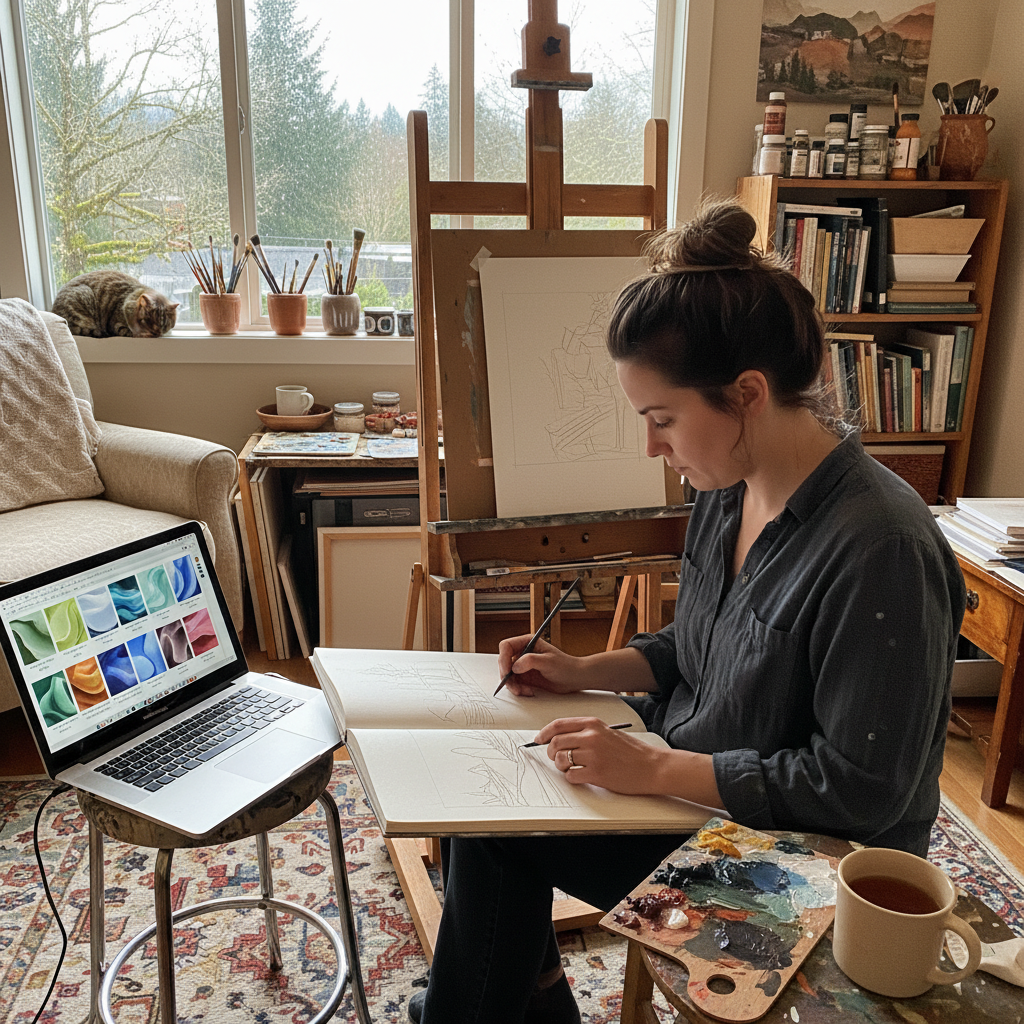
In towns like Astoria and Corvallis, I met artists who were curious—but cautious. One painter told me she uses AI in art to play around with color combinations when she’s feeling stuck. “It’s like tossing paint at a wall—sometimes you see something you didn’t expect,” she said. “But I’d never let it finish the work for me.”
That line—AI helps but doesn’t lead—is something I heard again and again. The final say still comes from the hand, not the code.
Oregon Students Are Building Art With Soul and Software
At schools like OSU and U of O, students are merging passion with creative technology in Oregon in exciting ways. From interactive poetry to emotion-sensitive installations, they’re showing that AI and artistry can coexist—if the balance is right.
A group of students in Eugene used AI storytelling tools to create a short film that changes based on audience reactions. The tech was cool, sure—but the takeaway was human. “The idea came from grief,” one student told me. “AI just helped us shape it.” It’s this blend of real emotion and digital support that’s giving young creators a new kind of voice.
Not Everyone’s Sold—And That’s Just Fine
There’s no pressure to plug in. A woodworker in Ashland shrugged when I asked about AI. “Doesn’t do much for me,” he said. “I make things to feel them. Machines don’t feel.” That quiet resistance is part of the scene here—and it’s respected.
In Oregon, opting out of tech isn’t a rejection of progress. It’s a reflection of values.
How Creatives in Oregon Are Actually Using AI
• For early brainstorming – A jumping-off point when inspiration runs dry.
• To cut back on busywork – Organizing footage, sketching outlines, testing color palettes.
• To explore, not finalize – Helping expand creative options without touching the final product.
• As one voice in the process – Never the lead, just part of the conversation.
Final Thoughts
Oregon doesn’t rush creativity. It listens. It wanders. It digs deep. And that’s why the way artists here are using AI in the creative process feels thoughtful, not trendy. They’re not chasing headlines—they’re asking if this helps tell the story better. If it does, they’ll use it. If not, they’ll move on.
Some are all in. Some aren’t interested at all. But in either case, whether it’s a filmmaker editing a passion project in Bend or a painter finding inspiration in an AI-rendered sketch, one thing’s clear:
Here in Oregon, the art still comes from people—with heart, with history, and with intention.